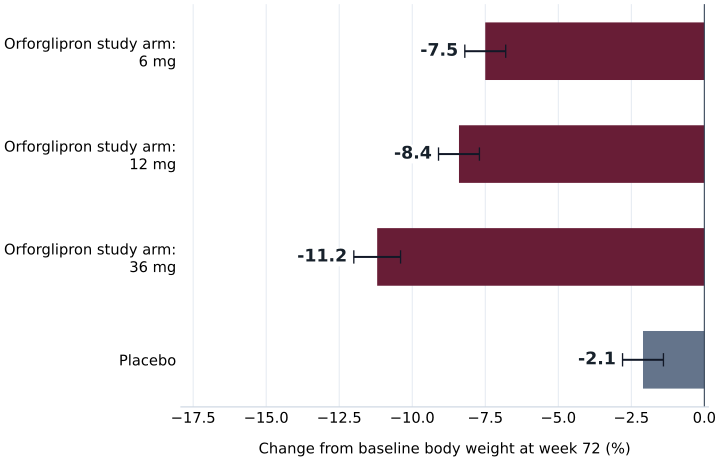
ATTAIN-1 offers substantial evidence that once-daily oral orforglipron reduces body weight more than placebo in adults without diabetes. Its main result was an average 11.2% weight reduction in the highest study-dose group over 72 weeks, compared with 2.1% with placebo. But that headline becomes useful only when its population, analysis, treatment discontinuations, and formulation are kept attached to it.
There is also an important regulatory update: Foundayo, the branded orforglipron tablet, received initial US approval in 2026. The investigational formulation used in ATTAIN-1 had different milligram doses from the marketed tablets. This analysis uses the indexed primary research abstracts and available official prescribing and FDA material—not a review of every trial protocol or supplement—to explain what the evidence establishes before it is translated into product comparisons or care-plan expectations.
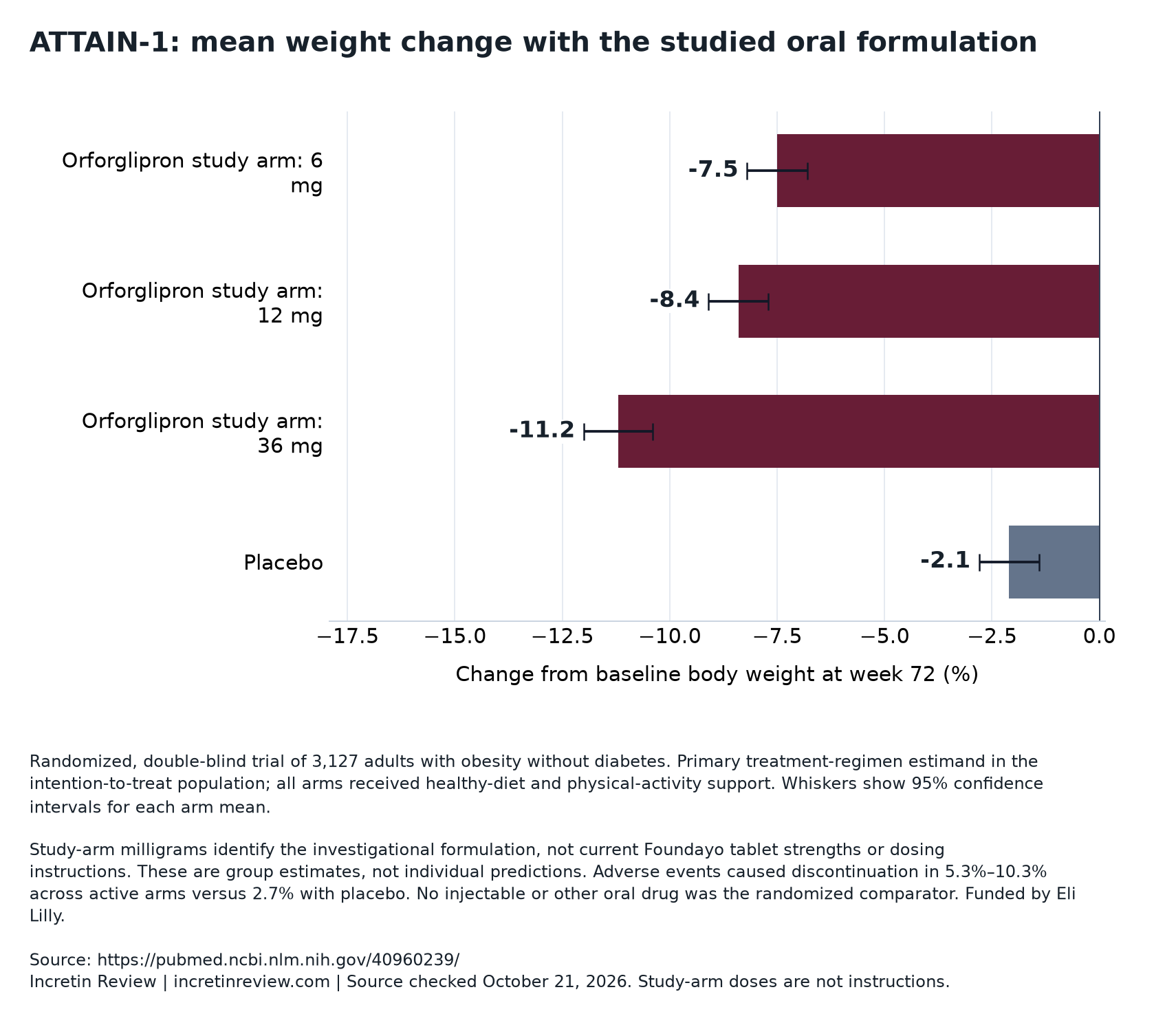
ATTAIN-1: mean weight change with the studied oral formulation
Randomized, double-blind trial of 3,127 adults with obesity without diabetes. Primary treatment-regimen estimand in the intention-to-treat population; all arms received healthy-diet and physical-activity support. Whiskers show 95% confidence intervals for each arm mean.
Study-arm milligrams identify the investigational formulation, not current Foundayo tablet strengths or dosing instructions. These are group estimates, not individual predictions. Adverse events caused discontinuation in 5.3%–10.3% across active arms versus 2.7% with placebo. No injectable or other oral drug was the randomized comparator. Funded by Eli Lilly.
Source 1Download the source-labeled chart (PNG) · Download the data (CSV)
| Study group | Reported value | 95% confidence interval |
|---|---|---|
| Orforglipron study arm: 6 mg | -7.5 | -8.2 to -6.8 |
| Orforglipron study arm: 12 mg | -8.4 | -9.1 to -7.7 |
| Orforglipron study arm: 36 mg | -11.2 | -12.0 to -10.4 |
| Placebo | -2.1 | -2.8 to -1.4 |
Sections in this article
What ATTAIN-1 actually tested
ATTAIN-1 was a multinational, phase 3, randomized, double-blind trial. Participants were assigned in a 3:3:3:4 ratio to oral orforglipron at investigational-formulation doses of 6, 12, or 36 mg daily, or placebo. Both drug and placebo were studied alongside diet and physical activity support. Randomization makes the placebo comparison more informative than simply tracking people who chose treatment.
The indexed abstract describes adults with obesity without diabetes. The official label gives the fuller eligibility description for the same registered trial: obesity, or overweight with at least one weight-related condition, excluding type 2 diabetes. Mean age was 45 years, 64% were female, mean body weight was 103.2 kilograms, and mean body mass index was 37. Those characteristics describe the study population, not eligibility or expected response for any particular reader.
The primary endpoint was percentage change in body weight from baseline to week 72. That is a weight-management endpoint, not a cardiovascular-event or survival endpoint. Eli Lilly funded the trial. As our guide to funding and trial design explains, sponsorship belongs in the assessment, alongside the protections and limitations of the actual methods.
Source 1 Source 2Why the primary analysis matters
The primary result used the treatment-regimen estimand in the intention-to-treat population. An estimand defines the treatment effect the analysis aims to measure. Here, the question concerns assignment to a treatment strategy, rather than restricting the answer to people who remained on treatment throughout the study. Intention-to-treat preserves the original randomized groups.
That distinction matters because discontinuation is part of treatment experience. An analysis focused on continued treatment can answer a different scientific question and produce a different estimate. The indexed primary report’s headline result is 11.2% weight loss in the highest study-dose group; a larger efficacy-oriented figure should not silently replace it in a comparison.
Nor does intention-to-treat eliminate missing-data assumptions. The label reports that week-72 weight measurements were missing for 14%–16% of active-treatment participants and 24% of placebo participants. Missing values were estimated using multiple imputation, which creates plausible datasets under stated assumptions. Our abstract-versus-full-paper guide explains why a precise headline still leaves methodological questions worth examining.
Source 1 Source 2Reading the weight changes without inflating them
All three active-treatment groups lost more weight on average than placebo. The reported mean reductions were 7.5%, 8.4%, and 11.2% as the investigational dose increased. Each comparison with placebo was statistically significant. The pattern supports a larger average effect at the highest tested dose, but the abstract does not establish that every active dose was statistically superior to every lower active dose.
Subtracting the placebo mean gives descriptive differences of 5.4, 6.3, and 9.1 percentage points. For example, 11.2% minus 2.1% is a 9.1-percentage-point separation—not an additional 11.2% attributable to treatment. These calculations do not supply confidence intervals for the between-group differences; those cannot be reconstructed by subtracting the endpoints of the separate intervals.
A 95% confidence interval expresses statistical uncertainty around an estimated group mean under the analysis assumptions. It is not the range within which 95% of individual weight changes occurred. The highest-dose interval, −12.0% to −10.4%, therefore indicates a relatively precise average estimate while leaving substantial room for person-to-person variation.
| Randomized study group | Mean body-weight change | 95% confidence interval |
|---|---|---|
| Orforglipron 6 mg | −7.5% | −8.2% to −6.8% |
| Orforglipron 12 mg | −8.4% | −9.1% to −7.7% |
| Orforglipron 36 mg | −11.2% | −12.0% to −10.4% |
| Placebo | −2.1% | −2.8% to −1.4% |
Responder thresholds show what the average hides
In the 36-mg investigational-formulation group, 54.6% of participants reached at least 10% weight loss, 36.0% reached at least 15%, and 18.4% reached at least 20%. The corresponding placebo proportions were 12.9%, 5.9%, and 2.8%. These results show that meaningful differences extended beyond a single average.
The thresholds overlap. Someone losing 20% also belongs to the groups losing at least 15% and at least 10%, so the percentages must not be added. A useful interpretation is that approximately 55 out of 100 participants reached the 10% threshold, while approximately 18 out of 100 reached the more demanding 20% threshold.
The absolute separation at the 10% threshold was 41.7 percentage points, calculated as 54.6 minus 12.9. That describes a difference in responder proportions, not a hazard reduction or an individual guarantee. Conversely, not reaching 10% does not necessarily mean no benefit: the abstract does not break that remaining group into smaller losses, unchanged weight, and weight gain.
Source 1Foundayo approval does not make trial milligrams interchangeable
Orforglipron is a small-molecule, nonpeptide GLP-1 receptor agonist. In plain language, it activates the human receptor used by the hormone GLP-1; it is not a peptide drug. The label connects its effects to reduced food intake, likely through decreased appetite, and also describes delayed stomach emptying. Shared receptor activity does not establish equal outcomes across different drugs or formulations.
Foundayo’s label lists initial US approval in 2026 and an indication for long-term weight reduction and maintenance in eligible adults, alongside reduced-calorie diet and increased physical activity. The trial abstract’s historical description of orforglipron as under investigation should not be repeated as its current regulatory status.
The label explicitly identifies the clinical-trial formulation as investigational and presents evidence using equivalent marketed dosages. The original 6-, 12-, and 36-mg research arms are therefore identifiers, not present-day tablet instructions or a conversion guide. The label’s highest-group mean of −11.1% also differs slightly from the primary abstract’s −11.2%; each should remain attached to its reporting source rather than being treated as a separate trial.
Source 1 Source 2Tolerability includes more than common nausea
ATTAIN-1’s most common adverse events were gastrointestinal and mostly mild to moderate. Nevertheless, adverse events caused treatment discontinuation in 5.3%–10.3% of active-treatment participants, compared with 2.7% receiving placebo. The abstract supplies a range across active arms; it does not support assigning each value to a specific study dose here, or calling every such discontinuation gastrointestinal.
The label provides broader safety evidence pooled across two weight-management trials, one of which included type 2 diabetes. Gastrointestinal reactions occurred in 60%–69% across the labeled active groups versus 37% with placebo. Severe gastrointestinal reactions were reported in approximately 3% versus 1%. These pooled results add detail but are not ATTAIN-1-only event rates.
The label also reports pooled acute kidney injury in 0.2% of treated participants versus 0.05% with placebo, and gallstones in 1% versus 0.7%. Six treated patients had adjudicated acute pancreatitis, compared with one placebo patient who experienced two events. These uncommon findings are clinically relevant, while their small counts limit precise comparisons of rare-event risk.
Source 1 Source 2The boxed warning requires a species-specific explanation
Foundayo carries a boxed warning about thyroid C-cell tumors. The scientific nuance is important: other GLP-1 receptor agonists that activate receptors in rats and mice have produced these tumors at clinically relevant exposures. Orforglipron is not pharmacologically active in those species and did not produce tumors in its rodent studies. The relevance of the receptor-dependent rodent findings to humans remains undetermined.
The label nevertheless contraindicates Foundayo in people with a personal or family history of medullary thyroid carcinoma or multiple endocrine neoplasia syndrome type 2. Serious hypersensitivity to the drug or its ingredients is another contraindication. Neither the absence of rodent tumors with orforglipron nor the trial’s mostly mild-to-moderate common events justifies describing the medicine as universally safe.
Other labeled concerns include pancreatitis, severe gastrointestinal reactions, dehydration-related kidney injury, gallbladder disease, and interactions affecting drug exposure or absorption. The label also addresses pregnancy, oral contraception, and anesthesia-related aspiration. These issues are distinct from average weight loss and help explain why an oral route does not remove the need for clinical assessment.
Source 2Oral semaglutide provides context, not a head-to-head ranking
OASIS 4 studied a different oral medicine: semaglutide 25 mg daily. It randomized 307 adults without diabetes, with overweight or obesity, to semaglutide or placebo plus lifestyle intervention. The study lasted 71 weeks, but its coprimary weight endpoints were assessed at week 64. Mean weight change was −13.6% versus −2.2%, an estimated difference of −11.4 percentage points, with a 95% confidence interval of −13.9 to −9.0.
That larger numerical reduction does not establish superiority over orforglipron. Participants were not randomized between these two oral drugs, and study size, timing, eligibility, and analysis can affect comparisons. OASIS 4 also found gastrointestinal events in 74.0% versus 42.2%; comparing those percentages directly with a different trial or pooled label dataset would not establish comparative tolerability.
SURMOUNT-5 illustrates the stronger design for a direct drug comparison: 751 participants were randomized between weekly subcutaneous tirzepatide and semaglutide for 72 weeks. It found greater mean weight reduction with tirzepatide, but it tested injections, not these oral regimens. Novo Nordisk funded OASIS 4; Eli Lilly funded SURMOUNT-5. Neither trial supplies a randomized oral orforglipron-versus-oral-semaglutide answer.
| Trial | Comparison and weight endpoint | Interpretive boundary |
|---|---|---|
| ATTAIN-1 | Oral orforglipron versus placebo; week 72 | Establishes benefit over placebo, not another active drug |
| OASIS 4 | Oral semaglutide 25 mg versus placebo; week 64 within a 71-week study | Provides separate oral-treatment evidence, not superiority over orforglipron |
| SURMOUNT-5 | Weekly injected tirzepatide versus injected semaglutide; week 72 | Direct comparison of the tested injectable regimens, not oral products |
Smaller waist and better markers are not clinical-event proof
ATTAIN-1 reported improvements in waist circumference, systolic blood pressure, triglycerides, and non-HDL cholesterol compared with placebo. The label supplies numerical detail: in its highest labeled group for the trial without diabetes, waist circumference fell 10 centimeters versus 3.1 centimeters with placebo, a difference of −6.9 centimeters with a 95% confidence interval of −7.8 to −6.0.
Systolic blood pressure fell 6.4 millimeters of mercury versus 1.4, while pulse increased 4.6 beats per minute versus 0.6. These changes show why cardiometabolic interpretation should examine several measures rather than summarize everything as uniformly improved health. The label marks the blood-pressure and pulse comparisons as not controlled for multiplicity, meaning they lack the same protection against false-positive findings across multiple tests.
The weight trial does not establish fewer heart attacks, strokes, or deaths from these marker changes. It also leaves questions about longer-term durability, outcomes after treatment withdrawal, and individual prediction. Our separate ESSENCE analysis of liver-biopsy evidence examines a related distinction: improvement in a measured disease indicator and proof of better long-term clinical outcomes are different evidentiary steps.
Source 1 Source 2Turning trial evidence into better care-plan questions
Editorial interpretation: ATTAIN-1 supports a drug-specific expectation under a studied treatment strategy, not a provider-specific outcome promise. It did not compare subscription services, pharmacy fulfillment models, appointment frequency, or contracts. A provider invoking the trial should not be assumed to reproduce its population, follow-up, or results.
Product identity is particularly important. FDA explains that compounded GLP-1 drugs are not FDA-approved and do not undergo the same premarket review for safety, effectiveness, and quality. Trial findings do not automatically transfer to compounded products, other formulations, or another route of administration. Our guide to when study results become marketing claims helps separate a supported statement from an unsupported extension.
Editorial interpretation: before comparing contract value, establish what product is actually proposed and what the written service terms cover. The Ro review and LillyDirect review can be starting points for checking documentary terms, not evidence that either service offers the studied regimen or achieves ATTAIN-1 outcomes. The study establishes neither a care-plan price advantage nor a provider ranking.
Source 1 Source 2 Source 5Questions about the evidence
Does 11.2% mean most participants lost exactly that much?
No. It is the estimated mean percentage change for the highest investigational-dose group under the primary analysis. Individual results varied. The responder results offer a different view: 54.6% reached at least 10% weight loss, while 18.4% reached at least 20%. Neither an average nor a threshold proportion predicts one person’s outcome.
Source 1Why are the trial doses different from Foundayo tablet strengths?
ATTAIN-1 used an investigational formulation. The current label explicitly presents evidence from that formulation using equivalent marketed dosages. The research-arm milligrams and marketed tablet milligrams should not be substituted for one another. This is a formulation distinction, not evidence that a reader should recreate a trial dose or calculate a personal conversion.
Source 1 Source 2Did more participants stop placebo than active treatment?
For stopping trial medication for any reason, yes: the label reports 30% with placebo versus 22%–24% across active groups in Trial 1. That differs from stopping because of adverse events, which was more frequent with orforglipron in the primary abstract. The two measures answer different questions and should not be used interchangeably.
Source 1 Source 2Does OASIS 4 show that oral semaglutide works better?
It shows that oral semaglutide outperformed its own placebo comparator at week 64. It does not establish superiority to orforglipron because the drugs were tested in separate randomized trials. A direct comparison would assign participants within one study to the competing oral regimens and evaluate them using a common design.
Source 1 Source 3Can these results be applied to adults with diabetes?
Not automatically. ATTAIN-1 excluded diabetes, and diabetes can change both treatment context and safety considerations. Foundayo’s label includes a separate randomized trial in adults with type 2 diabetes, with different weight results and additional hypoglycemia information. Those data should be examined on their own rather than importing the ATTAIN-1 average.
Source 1 Source 2Editorial assessment
ATTAIN-1 provides strong randomized evidence of greater average weight loss with oral orforglipron than placebo over 72 weeks in adults without diabetes. Its most useful interpretation combines the treatment-regimen estimate, responder distribution, discontinuations, and current formulation-specific labeling. It does not establish superiority over another oral drug, long-term cardiovascular benefit, or outcomes for a particular care provider. Foundayo’s approval resolves its regulatory status, not every comparative or long-term scientific question.
Research access and limitations
The research analyses here rely on indexed primary-report abstracts, supplemented by the official Foundayo label and FDA material. Full trial protocols, supplements, and individual participant data were not examined. Pooled label safety results include a separate diabetes trial and are identified as such; small numerical differences between the label and research abstract are retained rather than merged.
Source notes
Scientific sources checked October 21, 2026. Earlier research and provider sources retain their dated histories below. Provider pages document advertised terms. Study summaries identify the scope of our review.
- Orforglipron, an Oral Small-Molecule GLP-1 Receptor Agonist for Obesity Treatment.Indexed original research abstract · Checked 2026-10-21
- DailyMed - FOUNDAYO- orforglipron tablet, film coatedOfficial page retrieved in full · Checked 2026-10-21
- Oral Semaglutide at a Dose of 25 mg in Adults with Overweight or Obesity.Indexed original research abstract · Checked 2026-10-21
- Tirzepatide as Compared with Semaglutide for the Treatment of Obesity - PubMedPrimary source; original trial abstracts used for trial summaries · Checked 2026-10-21
- FDA — concerns with unapproved GLP-1 drugsRegulatory and safety context · Checked 2026-10-21